
If you run a retail store, you’ve probably noticed that static posters and printed displays just don’t grab attention the way they used to. Shoppers are used to screens everywhere — and LED digital signage is now one of the most effective tools to increase visibility, engagement, and sales at the point of sale. But what exactly should you look for? And is it worth the investment?
What Is Retail Digital Signage?
Retail digital signage refers to LED display systems installed inside or outside a store to communicate with customers in real time. This includes window displays, in-store product screens, promotional totems, and video walls. Unlike traditional printed materials, digital signage allows you to update content instantly, run multiple campaigns simultaneously, and attract attention with dynamic visuals — without printing costs.
How Digital Signage Increases Sales in Retail
Studies consistently show that dynamic displays outperform static ones. Here’s why it works:
- Captures attention faster.
- Moving images and bright LED screens naturally draw the eye, especially in busy shopping environments.
- Promotes impulse purchases.
- Displaying promotions or product highlights at the right moment — near the checkout or at the entrance — directly influences buying decisions.
- Reduces perceived wait times.
- Screens near queues keep customers engaged and improve the overall shopping experience.
- Enables real-time updates.
- Flash sales, price changes, seasonal campaigns — update everything remotely in minutes.
What to Look For When Choosing an LED Display for Your Store
Not all screens are the same. Here are the key factors to evaluate:
- Pixel Pitch This determines image sharpness. For indoor retail environments where customers are close to the screen, a pixel pitch of P1.5 to P2.5 is ideal. For window displays viewed from the street, P3 to P4 works well.
- Brightness Indoor displays typically need 800–1500 nits. For window-facing screens exposed to direct sunlight, you’ll need at least 4000–6000 nits to remain visible.
- Size and Format LED displays can be customized to any size or shape — a key advantage over traditional screens. From slim totems to full video walls, the format should match your store layout and branding.
- Content Management System (CMS) Choose a supplier that provides an easy-to-use CMS so your team can update content without technical skills.
Indoor vs. Window LED Display: Which Do You Need?
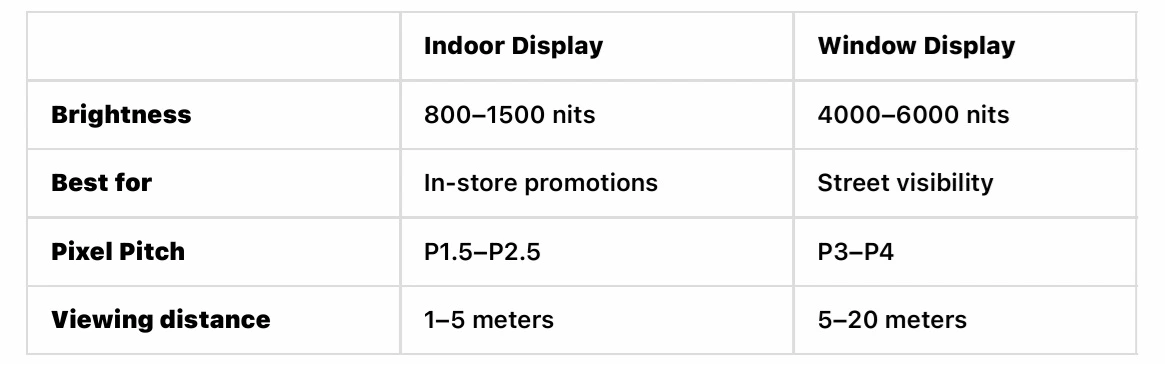
Many retailers use both: a high-brightness window display to attract foot traffic, and softer indoor screens to guide and engage customers inside.
Frequently Asked Questions
How much does a retail LED display cost? Costs vary significantly based on size, resolution, and installation requirements. Entry-level indoor totems start from a few thousand euros, while larger video walls can range from €10,000 upward. The ROI, however, is typically fast — many retailers report measurable sales increases within the first months.
Can I update the content myself? Yes. Modern LED display systems come with cloud based CMS platforms that allow you to schedule and update content remotely from any device.
How long does an LED display last? A quality LED display has an average lifespan of 50,000–100,000 hours, which means over 10 years of normal use with minimal maintenance.
Do I need a special installation? Installation requirements depend on the display type and size. A professional supplier will handle site assessment, installation, and after sales support.
Ready to Upgrade Your Store?
At NSELED Europe, we design and supply high-performance LED display solutions for retail environments across Europe. From compact totems to full custom video walls, we help brands create memorable in-store experiences.